The last post ended on a choice: settle the tax on your pre-tax retirement money now, under today’s rules, or find out later what it costs. A Roth conversion is how you settle it, under current tax law.
Most people picture a conversion as one big move, one big tax bill, one bad year. That picture is what stops them. It is also the least common way a conversion is actually done.
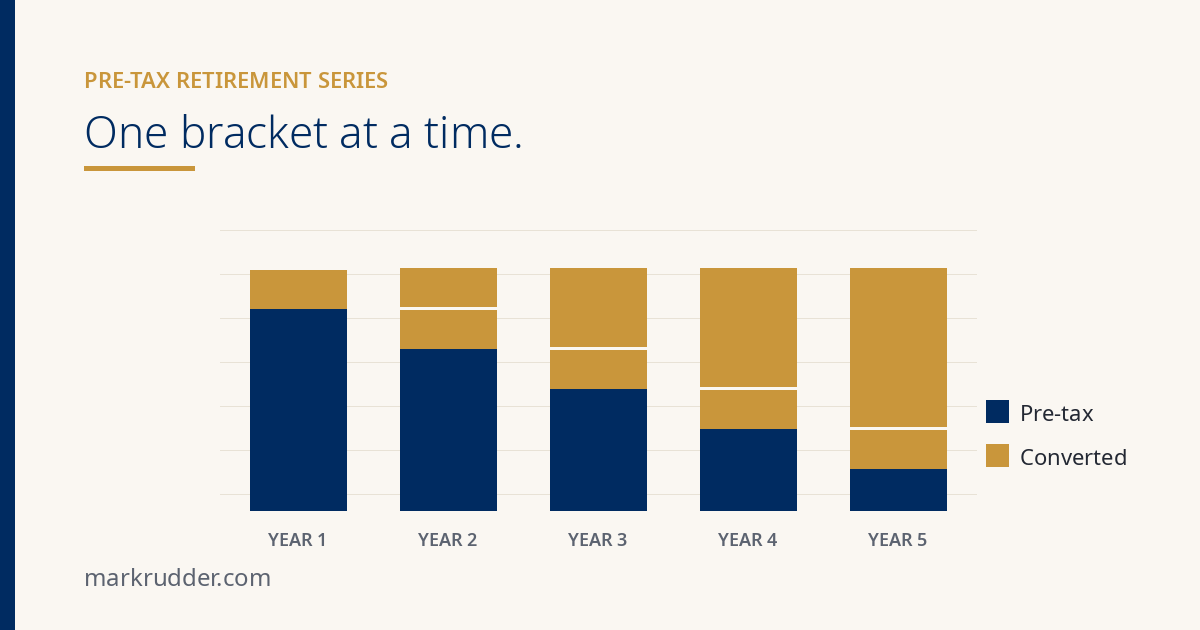
Done in stages, a Roth conversion is a series of small, deliberate moves, each one sized to a number you can see before you make it.
If you already know you want to look at your own numbers, you can schedule a conversation.
A Roth conversion moves money from a pre-tax account, usually a traditional IRA, into a Roth IRA. The amount you move is added to your taxable income for that year, and you pay income tax on it at that year’s rate. From then on, whatever the money earns is tax-free under current tax law, and withdrawals that meet the rules below come out the same way.
That is the whole mechanism. The rest of this post is about how much to move, when, and what to pay the tax with.
Your taxable income drives more than your tax bracket. The same number decides how much of your Social Security benefit is taxed, what you pay for Medicare Part B and Part D two years later, and, if you buy health insurance through the marketplace, whether you qualify for a premium credit.
Convert a large balance in one year and every one of those calculations moves at once. The tax bill is the part people expect. The higher Medicare premium that arrives two years later is the part they don’t.
There is a second problem with the one-big-move approach. A Roth conversion generally cannot be reversed. A conversion sized wrong can’t be undone; it can only be paid.
And a third. If the tax is withheld from the IRA itself, less money reaches the Roth. If you are under 59½, the amount withheld is treated as a distribution and may owe a 10 percent additional tax on top of the income tax.
These are factors to consider when determining whether a Roth conversion—and the timing or amount of any conversion—is appropriate.
If you have been putting this off because one big tax bill is the only version you have seen, that is exactly why we start with your numbers. No obligation, no pitch. We can help you evaluate the financial considerations and coordinate with your tax professional to determine whether a Roth conversion strategy may be appropriate.
Pick a target bracket, not a target dollar amount. Start with the income you already expect this year. Find how much room is left before the next bracket. That gap can help estimate how much may be converted before reaching the next federal income-tax bracket, subject to the taxpayer’s individual circumstances.
When appropriate, paying conversion taxes with funds outside the IRA may allow more of the converted amount to remain invested in the Roth IRA. Money from a checking or savings account covers the bill so the full converted amount lands in the Roth.
Know what day the value is set. You can convert cash or move shares directly. Either way, the taxable amount is the fair market value on the day the custodian processes the conversion, not the day you decided. If you are moving shares, that value can change between the two. Since there is no undo, the timing of the request matters.
If you are already taking required distributions, take this year’s first. An RMD cannot be converted. Satisfy it, then convert from what remains.
Next year, do it again. New income, new room, new decision.
The phrase “5-year rule” covers two different rules, and they trip up different people.
The first is one clock for your whole Roth IRA. It starts January 1 of the year of your first Roth contribution or conversion. Once five tax years have passed and you are at least 59½, earnings come out tax-free under current tax law. Your first conversion starts this clock if you have never had a Roth before, which is one argument for starting it sooner rather than later.
The second is a separate clock for each conversion. It matters if you are under 59½: withdraw a converted amount before its own five years are up and a 10 percent additional tax may apply. Once you reach age 59½, the 10% additional tax associated with this particular conversion five-year rule generally no longer applies, although other Roth distribution rules may still apply.
If you are past 59½ and this is your first Roth, the practical version is simple: the earnings clock is the one to watch, and it starts the year you convert.
A single large conversion is a one-time bet on this year’s rules against every future year’s. Staging turns it into a series of decisions. Each year you look at your income, the rules in effect, and how much of your pre-tax balance is still unsettled, and you decide again. Nothing forces you to finish.
A household that converts a third of its pre-tax balance over several years has settled that third under current tax law and left the rest open, on purpose. That is the split the last post described, and staging is how it gets built.
Where the converted money goes is a separate question. One option is a fixed indexed annuity issued as a Roth IRA, so the lifetime income it pays later is not taxed under current tax law, as long as you are at least 59½ and the Roth has been open at least five years. The tax treatment described above results from the Roth IRA tax status, not from the annuity itself. That is path two from the last post. See Future Tax Rates on Pre-Tax Retirement Accounts.
Guarantees are backed by the claims-paying ability of the issuing insurance company. Rider terms, costs, and restrictions vary by contract. The income benefit base is used to calculate lifetime income; it is not the contract’s cash value and is not available for lump-sum withdrawal.
It depends on the individual’s tax situation, income, age, objectives, and other circumstances. A full conversion adds the entire balance to one year’s income, which can push you into a higher bracket, raise Medicare premiums two years later, and make more of your Social Security benefit taxable. Converting in stages may help manage the amount of taxable income recognized in a particular year.
From money outside the IRA, if you can. If the tax is withheld from the IRA itself, less reaches the Roth, and if you are under 59½ the withheld amount may owe a 10 percent additional tax.
There are two. One clock for the whole Roth IRA governs when earnings become tax-free under current tax law: five tax years from your first contribution or conversion, plus age 59½. A separate clock for each conversion governs the 10 percent additional tax on early withdrawal of converted amounts, and stops applying at 59½.
A Roth conversion generally cannot be recharacterized back to a traditional IRA. Once the money moves, the tax is owed.
This information is provided for general educational purposes only and is not intended as tax advice. Roth conversion decisions can have significant tax consequences. Consult a qualified tax professional regarding your individual circumstances before implementing a Roth conversion.
You do not need to decide how much to convert. You need to know how much room you have in your bracket this year, and what it would cost to use it. That is a 30-minute conversation with your actual numbers on the table.
Ready to see where your retirement money actually stands? We walk through your numbers together. It takes about 30 minutes, costs nothing, and you leave knowing how much of your income is settled and how much is still open.
Sources: IRS Publication 590-A (2025), Contributions to Individual Retirement Arrangements, and Publication 590-B (2025), Distributions from Individual Retirement Arrangements. Tax Cuts and Jobs Act of 2017 (P.L. 115-97), §13611, recharacterization of Roth conversions. Social Security Administration, Medicare Premiums: Rules for Higher-Income Beneficiaries (2026).

Mark Rudder, Licensed Insurance Producer in Arizona · AZ #22110541
Michelle (Lanying) Li, Licensed Insurance Producer in Arizona · AZ #21573356
and Licensed Insurance Producer in California · CA #4390834
